Find Your Perfect Ride

 About Us
 Sustainability
 Perth to Bondi
 Reviews
 ACF x Vamos
 Blog


|
Quick Answer: Helmets are mandatory for every bicycle and e-bike rider in Australia, on every public road, bike lane, shared path and footpath. Your helmet must carry an approved certification mark, most commonly AS/NZS 2063 or European EN 1078. Fines range from about $50 in the NT to over $400 in NSW. |
Australia was the first country in the world to make bicycle helmets compulsory for all cyclists, starting in Victoria on 1 July 1990 and rolling out to the other states and territories by July 1992. The rule has held for more than three decades. The core idea is simple. Wear a helmet whenever you ride. The detail is where things get interesting, especially with e-bikes now the fastest-growing category of two-wheeled transport on Australian roads.
This page covers what counts as an approved bicycle helmet, the fines and exemptions in every state, how the rules apply on footpaths and shared paths, and where e-bike riders get caught out. If you ride a Vamos e-bike or any other legal e-bike, the same road rules apply as they do to a standard pushbike.
Key Takeaways
- Approved protective headgear is compulsory in every Australian state and territory. The only real exemption is the Northern Territory, where adults over 17 can ride helmet-free on footpaths and shared paths.
- A legal helmet must carry a certification sticker for AS/NZS 2063, EN 1078 or US CPSC, depending on the state.
- E-bike riders on a compliant 250W EPAC are legally "bicycle riders" and follow the same road rules as pedal cyclists, so every helmet rule applies to them the same way.
- Fines vary widely by state, from around $50 in the NT to $410 in NSW, and can be compounded with other cycling offences.
- A helmet that is unfastened, uncertified or expired counts as no helmet at all, and can reduce your compensation payout after a crash.
What Counts as an "Approved Bicycle Helmet"
Under Australian law, an approved bicycle helmet is a piece of protective headgear that meets a recognised safety standard, carries a certification mark, and is worn correctly fastened. Anything else, no matter how expensive or protective it looks, counts as no helmet at all in the eyes of the law.
The recognised standards come from Australia, Europe and the United States. Most states accept several. A few accept fewer.
The accepted standards
- AS/NZS 2063 (current version 2063:2020) is the Australian and New Zealand standard for helmets used on bicycles and wheeled recreational devices. It is accepted in every Australian jurisdiction.
- EN 1078 is the European standard for helmets for pedal cyclists and users of skateboards and roller skates. It is accepted in most Australian states.
- US CPSC 16 CFR 1203 is the American standard. It is also accepted in most Australian states.
- Snell B-95 is accepted in some states, including Tasmania and the Northern Territory.
Always check with your state road authority before travelling interstate with a helmet you bought overseas.
How to check your helmet is compliant
Every certified helmet has a sticker or sewn-in label, usually under the padding or near the back edge. The label should show the standard number (for example, AS/NZS 2063:2020) and the mark of an accredited certifier, such as BSI, SAI Global, or Global-Mark.
Watch for red flags. A missing label, a faded label, a certification printed only on the box, or a cheap online import with a suspicious sticker are all warning signs. If your helmet is not certified, it fails the legal test even if it looks the part. Wearing one on a public road is technically illegal.
Fit and fastening
The law requires the helmet to be securely fitted and fastened. That means:
- The chin strap sits snug, with room for no more than two fingers underneath.
- The helmet sits level on your head, with the front rim just above your eyebrows.
- The straps form a "V" just under each ear.
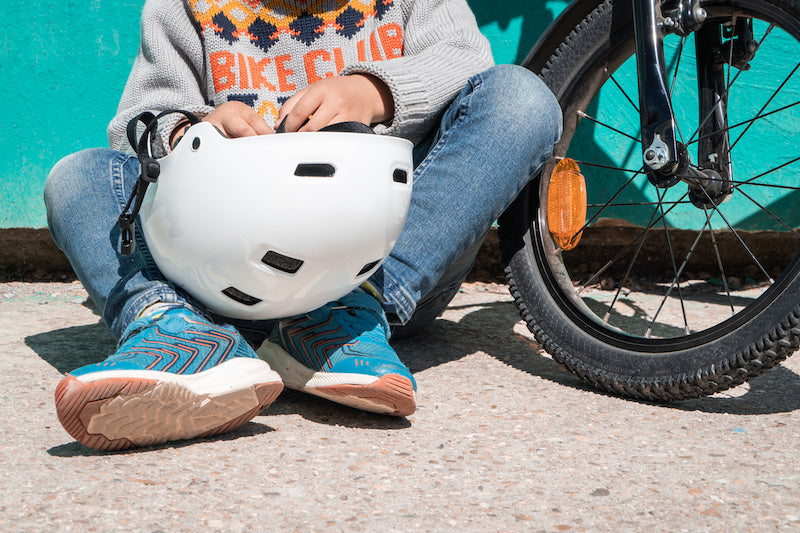
Replace your helmet after any significant impact, even if there is no visible damage. Foam only crushes once. Most manufacturers also recommend replacing your helmet every three to five years as the foam and straps degrade over time. A well-fitted helmet substantially reduces the risk of head injuries in a crash, which is exactly why the law exists in the first place.
What is NOT an approved bicycle helmet
- Skate helmets that are not marked to AS/NZS 2063 or EN 1078.
- Motorcycle helmets. These are built to AS/NZS 1698, a different standard that is not recognised for cyclists.
- Novelty or costume helmets.
- Damaged or expired helmets.
Helmet Laws State by State
Helmet law is set by each state and territory, so fines and accepted standards vary. The table below covers the headline numbers. Detailed notes for each state follow, with deeper coverage of the cities where Vamos riders live.
|
AS/NZS 2063 |
Approx. fine (helmet offence) |
Accepted standards |
|
NSW |
$410 (up to $2,200 in court) |
AS/NZS 2063, EN 1078, US CPSC |
|
VIC |
$231 (up to $925 in court) |
AS/NZS 2063, EN 1078, US CPSC |
|
QLD |
~$172 |
AS/NZS 2063, other approved equivalents |
|
WA |
~$50 |
AS/NZS 2063, EN 1078, US CPSC |
|
SA |
~$113 plus victims levy |
AS/NZS 2063, EN 1078, US CPSC |
|
TAS |
~$254 |
AS/NZS 2063, EN 1078, US CPSC, Snell B-95 |
|
ACT |
~$121 |
AS/NZS 2063, EN 1078, US CPSC |
|
NT |
$25 (adults exempt on footpaths / shared paths) |
AS/NZS 2063, EN 1078, Snell B-95 |
Fines are indicative and change with penalty-unit indexation each financial year. Always check the current amount with your state road authority before assuming.
New South Wales (Sydney)
NSW has the highest helmet fine in the country. Riding without an approved helmet on NSW roads, or with one that is not securely fastened, can cost you around $410 on the spot. The maximum penalty a court can impose is 20 penalty units, which amounts to $2,200.
NSW Police issue thousands of these notices each year and are known for active enforcement in the Sydney CBD and inner suburbs. The rule applies on every public road, bike lane, shared path and road-related area. It also applies to passengers being carried on a bicycle. Kids in child seats or bike trailers also need an approved helmet.
NSW is also in the middle of an e-bike compliance reset running through to 2029, so police, when stopping a rider for one issue, often check the whole compliance stack. If you commute through Sydney or ride any of the shared-path corridors like the Bay Run, Cooks River or Centennial Park, a properly certified and fastened helmet is the cheapest bit of insurance you can buy.
Source: Bicycle NSW, Sydney Criminal Lawyers via Mondaq
Victoria (Melbourne)
Victoria requires a helmet for every cyclist, e-scooter rider, and personal mobility device user on any public road, bike lane, shared path, or car park. The fine for failing to wear a helmet or for carrying a passenger who is not wearing one ranges from $231 to $925, depending on whether you take the matter to court.
The helmet rule in Victoria also covers passengers, including a child in an approved child seat or bike trailer. Melbourne riders have plenty of shared-path options like the Capital City Trail and Bay Trail where the rule applies just as strictly as on the road.
Victoria offers medical exemptions through VicRoads, but they require a written certificate. Adults can only ride on footpaths if they are supervising a child under 12 or have a medical certificate. Every rider must also stop at a pedestrian crossing and obey traffic lights as a driver does.
Source: RACV, VicRoads bicycle helmet rules
Queensland (Brisbane)
Queensland classifies bicycles as vehicles under the Transport Operations (Road Use Management, Road Rules) Regulation 2009. Regulation 256 requires every rider and passenger to wear an approved bicycle helmet, securely fitted and fastened. The definition of "approved bicycle helmet" covers AS 2063, AS/NZS 2063, or another standard that the chief executive considers at least equivalent.
The fine for a helmet offence was $166 as of July 2025, and Queensland fines and penalties increased by 3.5% on 1 July 2026 in line with government indexation. That puts the current amount at around $172. Queensland is also the first state to introduce a licence requirement for e-bike riders aged 16 and over, which means helmet fines can now stack with unlicensed-riding fines for anyone caught out. Brisbane riders should also note that QLD is one of the states where footpath cycling is legal, but only where the path is not marked "no bikes".
Source: Queensland Government (qld.gov.au), Queensland Law Handbook
Western Australia (Perth)
Cyclists of all ages in WA are permitted to ride on the road or on the footpath, but must wear an approved helmet at all times. The historical fine is among the lowest in the country, at around $50, and WA's cycling penalty framework is set out in the Road Traffic Code 2000.
Perth's Principal Shared Path network along the freeway corridors is one of Australia's best commuter cycling assets, and helmet compliance applies right through it. WA also requires bicycles to have a functioning rear brake, a bell or other warning device, a red rear reflector, yellow side reflectors on each wheel, and yellow reflectors along both edges of each pedal. If you are riding an e-bike in Perth, the same helmet rule that applies to pushbikes applies. WA also has a minimum age of 16 for e-bike riders.
Source: Go To Court, WA cycling rules
South Australia
South Australia follows the same core framework as NSW and Victoria. Riders and passengers must wear an approved helmet meeting AS/NZS 2063 or an equivalent, and it must be securely fastened. The helmet fine sits at around $113, with an additional victims-of-crime levy on top. SA's road rules for cyclists treat bicycles as vehicles, so all other cycling rules around lights, bells and shared paths apply.
Source: MyLicence SA (Government of South Australia), SA Law Handbook: Cycling
Tasmania
Tasmania takes the same broad approach as the other states and accepts AS/NZS 2063, EN 1078, US CPSC and Snell B-95 helmets. The helmet must have no visible defects and must be marked to one of these standards. The fine for riding without a properly fitted and fastened helmet is around $254, and it applies whether you are on a road, in a bike lane, on a shared path, or on a footpath.
Source: Transport Services Tasmania (Government of Tasmania)
Australian Capital Territory
The ACT operates broadly under the same standards framework as NSW and Victoria. AS/NZS 2063, EN 1078 and US CPSC are all accepted, and the rule applies to cyclists and PMD users alike. The fine for riding without an approved helmet sits at around $121. The ACT is one of the jurisdictions that also allows a religious exemption to the helmet rule, introduced under the ACT Road Safety Strategy.
Source: Transport Canberra (ACT Government), ACT Justice: Safe Cycling brochure
Northern Territory
The NT is the only Australian jurisdiction with a real adult exemption. If you are 17 or under, you must wear an approved helmet on public roads, footpaths and shared paths. If you are over 17, you are not required to wear a helmet on a public place or footpath, only when riding on the road. The NT accepts AS/NZS 2063, EN 1078 and Snell B-95 helmets. It also has the lowest cycling fine in the country at just $25.
Source: NT Government: Bicycle safety, NT Government: Cycling penalties
Helmet Laws for E-Bike Riders

E-bike riders often assume a different rule set applies. It does not. If your bike is a compliant EPAC (electrically power-assisted cycle) with 250W of continuous motor assistance that cuts out at 25 km/h, or a 200W throttle-only pedelec that cuts out at 25 km/h, you are a "bicycle rider" under Australian road rules. You follow the same road rules as any other pedal cyclist. Every helmet rule in this guide applies to you the same way it applies to a pushbike rider.
Where e-bike riders trip up is not the legal rule itself, but the practical stuff around it. Helmet standards were designed around impact speeds of roughly 20 km/h. A compliant e-bike cruises at the legal 25 km/h ceiling all day, which makes helmet quality and correct fit more consequential than they used to be.
A cheap-but-legal helmet still meets legal requirements, but the margin of safety is thinner at e-bike speeds. The fire risk from imported non-compliant lithium-ion batteries is also driving new state rules around what you can sell and ride, so buying a certified bike matters just as much as buying a certified helmet.
A few common traps to avoid:
- Imported helmets with no Australian-recognised sticker. If your e-bike arrived from overseas with a helmet in the box, check the certification. If there is no AS/NZS 2063, EN 1078 or US CPSC mark, it is not legal here.
- Assuming a faster non-compliant e-bike needs a motorcycle helmet. A bike that exceeds the legal EPAC limits is not a bicycle and is not a registrable motorcycle either. It is an unregistered motor vehicle, and no helmet fixes that.
- Not replacing a helmet after a low-speed e-bike crash. The bike frame might be fine, but foam only absorbs impact once. Replace the helmet.
If you carry a child on a cargo e-bike like the Amigo or Papa Grande, the child needs an approved helmet sized to fit. Adults carrying passengers also need to make sure the bike is designed to carry passengers and that the passenger has a proper seat.
Source: Vamos guide to Australian e-bike laws
Where the Rules Apply
Helmet law applies almost everywhere you can legally ride.
- Public roads and main roads. Helmet required in every state.
- Bike lanes and dedicated cycleways. Same as roads.
- Shared paths. Same rule. You also need to give way to pedestrians and use a bell.
- Footpaths. Legal for cyclists in QLD, ACT, NT, TAS and a few other jurisdictions. Not legal for adults in NSW. Where footpath riding is legal, the helmet rule still applies (except for adults over 17 in the NT).
- Public areas and road-related areas such as car parks, plazas and open public reserves. Helmet required.
- Private property. No legal requirement, but it's a smart choice to wear one anyway, especially for kids.
Exemptions to Helmet Laws
The bar for a helmet exemption is high. The common categories are:
- Medical reasons. Every state allows an exemption on medical grounds. The process usually requires a written certificate from a registered medical practitioner. Each state has its own application form and criteria, so check with your local road authority.
- Religious head coverings. Some states allow an exemption where a religious head covering makes a helmet impractical. The process is usually the same as the medical exemption pathway.
- The Northern Territory adult footpath exemption. Adults aged 17 and over in the NT can legally ride helmet-free on footpaths and shared paths, but a helmet is still required on the road.
Things that are not exemptions: a short trip, forgetting your helmet, riding a hire bike or a shared e-bike, or being a tourist.
Fines and Penalties
Helmet fines vary widely across Australia. NSW sits at the top of the range at around $410, followed by Tasmania at around $254 and Victoria at $231. WA and the ACT are cheaper at $50 to $121. The NT has the lowest fine in the country at $25.
Cyclists do not accumulate demerit points in most states, because you do not need a licence to ride a pushbike. The exception is Queensland, where riders aged 16 and over on an EPAC will need at least a learner's licence, and can then accumulate demerit points against that licence.
Fines really add up when they stack. A rider caught at night without a helmet and without a working white light, riding on the footpath while holding a mobile phone, can incur four separate infringements in a single stop. In NSW, a mobile-phone-while-riding offence alone can cost $425.
The underrated cost is what happens if you are involved in a crash. A rider who was not wearing an approved helmet, or whose helmet was not properly fastened, can see their compensation payout reduced for contributory negligence. That risk usually dwarfs the fine itself.
Beyond Helmets, The Other Gear the Law Requires
Helmet law is the headline rule, but a bicycle also has to be roadworthy. In most states you need:
- At least one working brake.
- A bell, horn or other audible warning device.
- A white front light and red rear light visible from 200 metres, plus a red rear reflector, when riding at night or in low-light conditions.
You cannot ride while holding a mobile phone. Hands-free operation using a handlebar cradle is generally allowed, subject to state-specific rules. You can only carry passengers on a bike that is designed for it, using a proper passenger seat. You cannot hold on to a moving motor vehicle while riding. Cyclists must also stop at traffic lights, give way at a pedestrian crossing, and behave predictably around drivers and other road users to stay safe on the road.
Ride Legal. Ride Vamos.
The law is the easy part. Wear an approved helmet, keep your bike roadworthy, and comply with your state's rules. The harder part is picking a bike that is genuinely built to be legal, safe and enjoyable on Australian roads in the long term.
That is what Vamos does. Every Vamos e-bike is designed around Australia's 250W / 25 km/h EPAC framework, with battery certification, build quality, and a ride feel that make you want to gear up and go. Whether you commute in Sydney, ride the Perth PSP, tackle Melbourne's Bay Trail or cruise Brisbane's Bicentennial Bikeway, we have a bike built for it. Pair it with a helmet from our helmet range, and you are legal, protected and ready to ride alongside other riders on any Australian road.
Not sure which bike suits you? Take our find your perfect ride quiz, and we will help you narrow it down.
Frequently Asked Questions
Do I have to wear a helmet on an e-bike in Australia?
Yes. A compliant e-bike is a "bicycle rider" under Australian road rules, so the same helmet law applies as it does to a pushbike. That means an approved helmet, worn on every road, bike lane and shared path in every state and territory.
Is an EN 1078 helmet legal in Australia?
Yes, in every Australian state and territory that recognises the European standard, which includes NSW, Victoria, Queensland, WA, SA, Tasmania, ACT and the NT. Always check the sticker before you ride and look for the CE mark alongside the EN 1078 reference.
What's the fine for riding without a helmet in NSW?
Around $410 on the spot in NSW, which is the highest helmet fine in the country. The maximum a court can impose is 20 penalty units, currently $2,200. NSW Police actively enforce the rule, especially in the Sydney CBD and inner suburbs.
Are there any Australian states where adults don't have to wear a bike helmet?
Only the Northern Territory. Adults 17 and over can ride helmet-free on footpaths and shared paths in the NT. On public roads, a helmet is still required, and children of any age must wear one.
How often should I replace my bike helmet?
Replace your helmet after any significant impact, even if there's no visible damage, because the protective foam crushes only once. Most manufacturers also recommend replacing every three to five years, since the foam and straps degrade over time even without a crash.